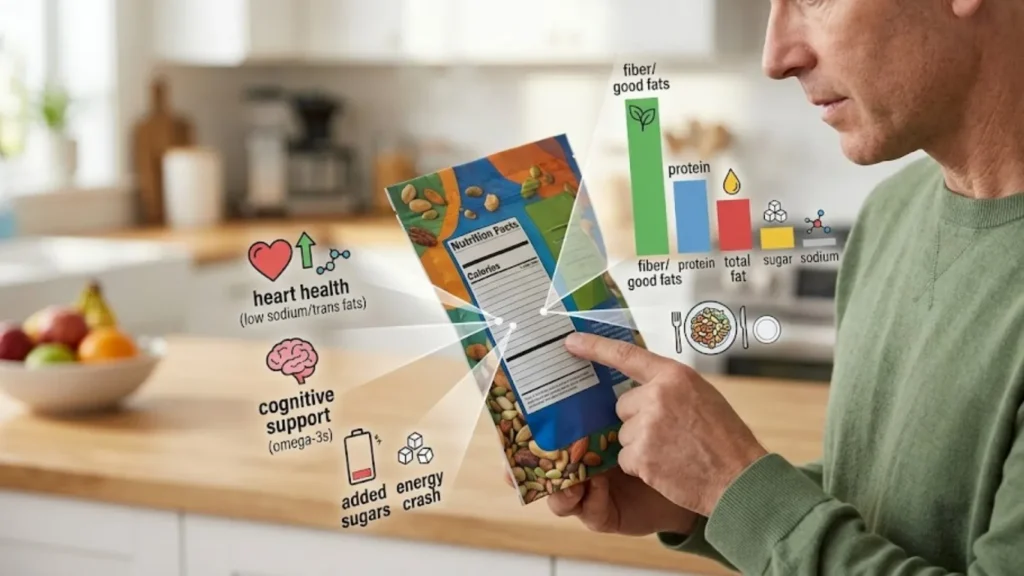
The front of a packet is marketing. The back is regulated. Almost every misleading impression a shopper forms comes from reading the first and not the second – and the gap between the two is where most avoidable sugar, salt and refined flour enters an Indian kitchen.
Start With Per 100 g, Not Per Serving
This is the most exploited number on any Indian label. Manufacturers choose their own serving size, and they choose it to flatter the product. A biscuit packet may declare a serving of two biscuits when nobody eats two. A namkeen pack may use 30 grams when the packet holds 150.
Always read the per-100-gram column. It is the only figure that lets you compare two products honestly. Then, separately, ask yourself how much you will genuinely eat.
The Numbers That Matter
| Per 100 g | Low (good) | High (limit) |
|---|---|---|
| Total sugar | 5 g or less | More than 22.5 g |
| Salt | 0.3 g or less | More than 1.5 g |
| Saturated fat | 1.5 g or less | More than 5 g |
| Fibre | – | 6 g or more is good |
| Protein | – | 10 g or more is meaningful |
If a label lists sodium rather than salt, multiply sodium by 2.5 to get the salt figure. A product with 800 mg sodium per 100 g contains about 2 g of salt per 100 g, which is high.
The Ingredient List Tells the Real Story
Ingredients are listed in descending order by weight. That single rule exposes more than the nutrition panel does. If refined wheat flour appears first on a biscuit that advertises whole grains, the product is mostly maida. If sugar appears in the first three ingredients, it is a sugar-based product regardless of what the front says.
Watch for sugar split across multiple names, which pushes each individual entry further down the list. All of these are sugar:
- Invert sugar syrup, liquid glucose, glucose-fructose syrup
- Maltodextrin, dextrose, maltose
- Fruit juice concentrate
- Honey, jaggery, date syrup, cane juice – nutritionally almost identical to sugar
- Corn syrup solids
Decoding the Claims
| Claim | What it actually means |
|---|---|
| No added sugar | No sugar added during processing – may still be high in natural sugars |
| Sugar-free | Below a very small threshold; usually contains artificial sweeteners |
| Made with whole wheat | Some whole wheat is present – check where it sits in the ingredient list |
| Multigrain | Contains more than one grain; says nothing about refinement |
| Zero trans fat | May round down small amounts – check for partially hydrogenated oil in the ingredients |
| Fortified | Nutrients added; does not make a refined product a whole food |
| Natural | Not a regulated nutrition claim in any meaningful sense |
| High protein | Compare per 100 g against the 10 g benchmark before believing it |
Indian-Specific Things to Check
- The green or brown mark. Green square means vegetarian; brown or red means non-vegetarian. Check it on processed foods where the ingredients are not obvious.
- The FSSAI licence number. A 14-digit number should appear on every packaged food. Its absence is a genuine warning sign.
- Oil type. Palm oil is common and cheap and is high in saturated fat. It is often listed simply as edible vegetable oil, which tells you little.
- Best before versus use by. Use by is a safety date. Best before is a quality date.
- Serving suggestions in images. The pictured serving usually includes items not in the packet.
- Front-of-pack ratings where present. Useful at a glance, but the back panel is still the arbiter.
Five Products Worth Checking Tonight
- Breakfast cereal and muesli – frequently 20 to 30 g sugar per 100 g despite health positioning
- Fruit juices and nectars – often little different from a soft drink once you read the sugar line
- Brown bread – commonly refined flour with caramel colour; look for whole wheat flour listed first
- Protein biscuits and bars – protein claims on a base of refined flour, sugar and fat
- Ready masala and instant mixes – among the highest sodium products in most kitchens
Frequently Asked Questions
Is jaggery healthier than white sugar?
Marginally, in that it retains trace minerals. Metabolically your body treats it as sugar. Use it because you prefer the taste, not because it is a health food.
Should I avoid everything with a long ingredient list?
Not automatically – some long lists are fortification. But a long list dominated by refined flour, sugars, oils and stabilisers usually signals an ultra-processed product.
Are artificial sweeteners safe?
Approved sweeteners are considered safe at normal intakes. They help reduce sugar in the short term; whether they help long-term eating habits is less clear.
How much sodium should I have in a day?
The WHO recommends under 2,000 mg of sodium daily, roughly 5 g of salt. Most Indian diets substantially exceed this, largely from packaged foods, pickles and papads rather than the salt shaker.
About the Author
Nidhi Kakar is a nutritionist and the founder of Art of Wellness. She specialises in women’s health through the midlife years, from the mid-30s to the mid-60s, and has guided hundreds of women through perimenopause, menopause, and post-menopause with personalised nutrition and lifestyle plans.
This article is for educational purposes and does not replace personalised medical advice. Speak to your doctor about symptoms, tests and treatment that apply to you.